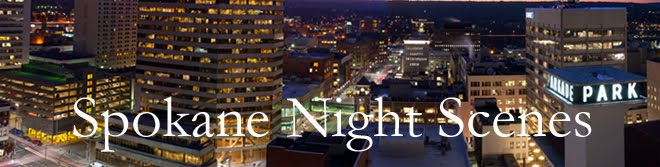
So, the goal of this shoot was to find color, during the Christmas season, in downtown Spokane. I was hoping to find color in places other than where the “usual suspects,” are.
On the south side of the Lincoln building at Riverside and Lincoln, I found color atop the Lincoln buildings southern walls, looking straight up.
http://www.spokanenightscenes.com/linc.htm
http://www.spokanenightscenes.com/linc2.htm
http://www.spokanenightscenes.com/linc3.htm
I’m not a traditional practitioner of shooting “leading lines,” but I think that all the different angles and lines are helpful in displaying the color on top of the Lincoln building.
JDM
Sunday, December 20, 2009
Wednesday, December 02, 2009
Spokane Night Photographers
And so the fun begins
Night shooting is a lot of fun. If it isn’t, you are doing it wrong.
One way to get started, at least locally, is to join up with a number of other night shooters who go out with me once or twice a month, to shoot different types of locations. No cost involved, and you can have both fun, and also learn some things. Right now, I have about 30 listed night shooters, who attend the on-location shoots. I tend to break the groups down into smaller numbers instead of getting thirty out there at once, but my groups tend to run about 12-14 people at each location.
For me, this is the “season.” It gets dark early, and you can shoot at night without having to spend all night outdoors carting all of your gear around. This past Sunday, I was joined by about a dozen photogs on the Riverpoint Campus just east of downtown Spokane. My goals of the evening were to get the photogs into a situation that they would have to begin to manage high intensity lighting features. After about 45 minutes, I took them to a second location on the Riverpoint Campus where there was darkness, and almost the exact opposite of what they shot earlier.
Exposure to these situations can be helpful in the future, and having other photogs around can give everyone different ideas. All of these events are “outside the box opportunities.” There is usually more than one way to accomplish each objective, but after developing a workflow at a location, it can prepare you to deal with just about anything in front of the lens.
It isn’t a secret that I love shooting night scenes. To invite all of these folks out to different locations and see them enjoy what they are doing, make a few hours a totally enjoyable experience. Some of the night shooters are not affiliated with any local camera or photo organization. Some are members of the Spokane Camera Club, Spokane Valley Camera Club, Photographic Society of America, or Inland Outlook Photo Club. Some are very basic shooters, some are moderately experienced, and a few are advanced level photographers. The varied skill levels are very helpful in developing answers to photogs questions who are using a variety of camera equipment brands.
Did I mention that night shooting was fun? Of course I did, and it is a lot of fun. I tend to take my groups to areas I have shot before, and I leave my cameras at home in the office. It was hard for me to do that in the beginning, but I found out that coaching and helping some of the others cannot be done successfully if I am trying to shoot for myself. So, I develop my targets and visit them either before, or after the evenings I schedule night shoots around Spokane.
We have room for more shooters, if you want to visit Spokane locations after dark with some others who want to try to broaden their shooting skills. Let’s face it. We live in a beautiful place, and it actually gets prettier as the sun goes down. Lots of different things going on, different lighting and activity centers, and lots of motion. For years I saw very, very, few photographers after dark. Now, I get to visit with at least a dozen or so each time a new night shoot is scheduled. Breaking the existing group in half to shoot the same location on different evenings has been helpful in managing the numbers of photogs in attendance. I am interested in challenging each of the night shooters to a full blown Spokane project, in the future. Something that would combine the developed skills of ALL the photographers, into a single objective. I am testing the waters right now with my local Spokane community contacts, but for now all I can say is stay tuned for a fairly large Spokane project which can use all of the photographers in one evening’s project.
JDM
Night shooting is a lot of fun. If it isn’t, you are doing it wrong.
One way to get started, at least locally, is to join up with a number of other night shooters who go out with me once or twice a month, to shoot different types of locations. No cost involved, and you can have both fun, and also learn some things. Right now, I have about 30 listed night shooters, who attend the on-location shoots. I tend to break the groups down into smaller numbers instead of getting thirty out there at once, but my groups tend to run about 12-14 people at each location.
For me, this is the “season.” It gets dark early, and you can shoot at night without having to spend all night outdoors carting all of your gear around. This past Sunday, I was joined by about a dozen photogs on the Riverpoint Campus just east of downtown Spokane. My goals of the evening were to get the photogs into a situation that they would have to begin to manage high intensity lighting features. After about 45 minutes, I took them to a second location on the Riverpoint Campus where there was darkness, and almost the exact opposite of what they shot earlier.
Exposure to these situations can be helpful in the future, and having other photogs around can give everyone different ideas. All of these events are “outside the box opportunities.” There is usually more than one way to accomplish each objective, but after developing a workflow at a location, it can prepare you to deal with just about anything in front of the lens.
It isn’t a secret that I love shooting night scenes. To invite all of these folks out to different locations and see them enjoy what they are doing, make a few hours a totally enjoyable experience. Some of the night shooters are not affiliated with any local camera or photo organization. Some are members of the Spokane Camera Club, Spokane Valley Camera Club, Photographic Society of America, or Inland Outlook Photo Club. Some are very basic shooters, some are moderately experienced, and a few are advanced level photographers. The varied skill levels are very helpful in developing answers to photogs questions who are using a variety of camera equipment brands.
Did I mention that night shooting was fun? Of course I did, and it is a lot of fun. I tend to take my groups to areas I have shot before, and I leave my cameras at home in the office. It was hard for me to do that in the beginning, but I found out that coaching and helping some of the others cannot be done successfully if I am trying to shoot for myself. So, I develop my targets and visit them either before, or after the evenings I schedule night shoots around Spokane.
We have room for more shooters, if you want to visit Spokane locations after dark with some others who want to try to broaden their shooting skills. Let’s face it. We live in a beautiful place, and it actually gets prettier as the sun goes down. Lots of different things going on, different lighting and activity centers, and lots of motion. For years I saw very, very, few photographers after dark. Now, I get to visit with at least a dozen or so each time a new night shoot is scheduled. Breaking the existing group in half to shoot the same location on different evenings has been helpful in managing the numbers of photogs in attendance. I am interested in challenging each of the night shooters to a full blown Spokane project, in the future. Something that would combine the developed skills of ALL the photographers, into a single objective. I am testing the waters right now with my local Spokane community contacts, but for now all I can say is stay tuned for a fairly large Spokane project which can use all of the photographers in one evening’s project.
JDM
Tuesday, November 17, 2009
Night shooters FAQ's
Here are some questions that have come in this morning, as well as from other night shooters.
Do I need a tripod?
The short answer is yes. Image stabilization might be terrific for single shots, but to combine a series of shots means, your PLATFORM CANNOT move. You have to shoot multiple shots from exactly the same spot and camera position. Blending them, or layering them in post shooting processes will produce a finished shot.
Do I need a flashlight?
Yes, you do. Working with a piece of equipment after sunset presents a series of intellectual challenges for all night shooters. This is not just present in basic or midlevel shooters. To streamline your efforts of being able to get around a site safely, and to get around your camera quickly, you need to bring a light.
I tend to operate with multiple lights including a headlamp, and also a small handheld flashlight. I like to use red filters or lenses to mitigate night blindness for myself as well as others who might also be shooting in the same area. When the red filter is not necessary, you use plain old white light to get around safely.
What do I wear?
Not a silly question, as was asked by a couple of photogs locally. This time of year it can get cold, and based on the last two winters in Spokane, we are quite familiar with all of that stuff. Comfortable clothing, usually several light layers. Visibility at night can be important, especially if you are in and around traffic, so a lighter colored or reflective outer layer might be recommended.
Shoes? Yep, bring them along. Sturdy shoes or boots are a must for shooting after dark. Kinda silly? No, not really, since falls with expensive equipment can ruin anyone’s evening. Falls on ice, can cause more than just injury to equipment, so good sturdy shoes are a must.
How many shots do I need?
Interesting question, well, sorta interesting. Some shooters have written me and advised that they can get what they want in only one shot. I think that is outstanding, if it is really what is happening. I have never really had much success with one shot night shooting efforts. On some night shoots I average 400 images at one site, and add them together (not all of them) after they are reviewed on the computer.
At the least I need three shots at a location, which will produce a final outcome. In determining a start point, you can use the viewfinder to determine a start point (or rear screen display). A start point will allow you to view much of the detail of the image, especially in the darkest (shadow) spots. This same view will also show you that your lights (highlights) are almost always totally blown out, but the details look good. Once you have reached the start point, then I shoot one series at this point. Following that I INCREASE the shutter speed, normally quite a bit. This almost always takes away the detail you saw before, but what you also see is that the highlights (ambient lighting) is now very visible without being blown out at all. After being satisfied with the fastest shutter speed shot, you do the opposite, which means you now slow down the shutter speed, and go beyond the spot you found earlier which showed much of the detail. This will really be blown out as far as highlights go, but you will lack very little in detail that is hiding in the shadows. I shoot totally in MANUAL, so I can determine what it is the camera is doing. This type of workflow may be a little different than some other photogs, but it works for me.
What is important now is that in ALL of these different shots, you have NOT MOVED THE TRIPOD OR CAMERA. Combining the three views of your shot are now the editing challenge, but it is likely to reveal a great view of a location after darkness. A wireless shutter release, or tethered shutter release are helpful. It is also helpful to have setup the basics of the camera before you got to the site, so you do not have to worry about adjusting ISO levels or FStops. Determine those in advance and then leave them alone...you only need to adjust shutter speed after that.
Sound simple? Well, it sorta is. Each location has its issues though, but if you go to these sites with some basic tools to work with, you can make the site and camera modifications required. In most cases you only need to adjust a shutter speed.
John
Do I need a tripod?
The short answer is yes. Image stabilization might be terrific for single shots, but to combine a series of shots means, your PLATFORM CANNOT move. You have to shoot multiple shots from exactly the same spot and camera position. Blending them, or layering them in post shooting processes will produce a finished shot.
Do I need a flashlight?
Yes, you do. Working with a piece of equipment after sunset presents a series of intellectual challenges for all night shooters. This is not just present in basic or midlevel shooters. To streamline your efforts of being able to get around a site safely, and to get around your camera quickly, you need to bring a light.
I tend to operate with multiple lights including a headlamp, and also a small handheld flashlight. I like to use red filters or lenses to mitigate night blindness for myself as well as others who might also be shooting in the same area. When the red filter is not necessary, you use plain old white light to get around safely.
What do I wear?
Not a silly question, as was asked by a couple of photogs locally. This time of year it can get cold, and based on the last two winters in Spokane, we are quite familiar with all of that stuff. Comfortable clothing, usually several light layers. Visibility at night can be important, especially if you are in and around traffic, so a lighter colored or reflective outer layer might be recommended.
Shoes? Yep, bring them along. Sturdy shoes or boots are a must for shooting after dark. Kinda silly? No, not really, since falls with expensive equipment can ruin anyone’s evening. Falls on ice, can cause more than just injury to equipment, so good sturdy shoes are a must.
How many shots do I need?
Interesting question, well, sorta interesting. Some shooters have written me and advised that they can get what they want in only one shot. I think that is outstanding, if it is really what is happening. I have never really had much success with one shot night shooting efforts. On some night shoots I average 400 images at one site, and add them together (not all of them) after they are reviewed on the computer.
At the least I need three shots at a location, which will produce a final outcome. In determining a start point, you can use the viewfinder to determine a start point (or rear screen display). A start point will allow you to view much of the detail of the image, especially in the darkest (shadow) spots. This same view will also show you that your lights (highlights) are almost always totally blown out, but the details look good. Once you have reached the start point, then I shoot one series at this point. Following that I INCREASE the shutter speed, normally quite a bit. This almost always takes away the detail you saw before, but what you also see is that the highlights (ambient lighting) is now very visible without being blown out at all. After being satisfied with the fastest shutter speed shot, you do the opposite, which means you now slow down the shutter speed, and go beyond the spot you found earlier which showed much of the detail. This will really be blown out as far as highlights go, but you will lack very little in detail that is hiding in the shadows. I shoot totally in MANUAL, so I can determine what it is the camera is doing. This type of workflow may be a little different than some other photogs, but it works for me.
What is important now is that in ALL of these different shots, you have NOT MOVED THE TRIPOD OR CAMERA. Combining the three views of your shot are now the editing challenge, but it is likely to reveal a great view of a location after darkness. A wireless shutter release, or tethered shutter release are helpful. It is also helpful to have setup the basics of the camera before you got to the site, so you do not have to worry about adjusting ISO levels or FStops. Determine those in advance and then leave them alone...you only need to adjust shutter speed after that.
Sound simple? Well, it sorta is. Each location has its issues though, but if you go to these sites with some basic tools to work with, you can make the site and camera modifications required. In most cases you only need to adjust a shutter speed.
John
Sunday, November 15, 2009
Spokane Regional Clean Air Agency has contracted with Spokane Night Scenes
The Spokane Regional Clean Air Agency has contracted with Spokane Night Scenes for licensed image use (2 images) for their new 2010 Calendar.
The images chosen by the Spokane Regional Clean Air Agency for the 2010 Calendar are:
http://www.spokanenightscenes.com/jundt.htm
http://www.spokanenightscenes.com/patsyclark.htm (second image)
JDM
The images chosen by the Spokane Regional Clean Air Agency for the 2010 Calendar are:
http://www.spokanenightscenes.com/jundt.htm
http://www.spokanenightscenes.com/patsyclark.htm (second image)
JDM
Spokane Night Scenes chosen for 2010 Spokane Relocation Guide
Greater Spokane Incorporated
The Spokane Chamber and Spokane EDC have contracted with Spokane Night Scenes for a cover image for their new 2010 Spokane Relocation Guide. A sample of the 2009 relocation guide is here:
http://www.relocatespokane.com/
A low resolution image of the Spokane Night Scenes image chosen by Greater Spokane Inc., is located here:
http://www.spokanenightscenes.com/clocktowereast.htm
We are lucky to live in a beautiful place, and those relocating to Spokane will find out soon.
JDM
The Spokane Chamber and Spokane EDC have contracted with Spokane Night Scenes for a cover image for their new 2010 Spokane Relocation Guide. A sample of the 2009 relocation guide is here:
http://www.relocatespokane.com/
A low resolution image of the Spokane Night Scenes image chosen by Greater Spokane Inc., is located here:
http://www.spokanenightscenes.com/clocktowereast.htm
We are lucky to live in a beautiful place, and those relocating to Spokane will find out soon.
JDM
Thursday, November 12, 2009
Mission Street bridge, Spokane, Washington
I have been involved in a neighborhood photo shoot for the past two weeks, and as I drove to the target neighborhood, I noticed some reflections from the Mission Street Bridge. This bridge came to my attention as City crews labored on the bridge with equipment lowered over the side of the bridge. It appeared they were doing repairs or inspections (or both). It seemed like a potential target for the cameras after dark, largely because of the reflection potential.
A couple of nights ago I made it to the Mission Street Bridge about 30 minutes after sunset. The reflections were not as pronounced as I anticipated, but I grabbed the Canon with the wide angled lens (11x18), and decided to shoot the bridge anyhow. I wanted to try and capture some automobile traffic lights crossing the bridge, although most of the headlights were below the walls on the sides of the bridge.
I started with 15 second exposures, but it was apparent with those shots that this was going to take much longer exposures to capture the details of the bridge. I settled on 1 minute BULB exposures at F8, and ISO 100. The one minute exposures helped tame the ambient lights, but much of the details were still too dark. By the time I opened up the shutter for about two minutes, the details became apparent. I settled on images of 1:45 and 2:13 and blended those the following day on the computer. It is amazing how dark it can get in areas without street lights, even if you are shooting towards much brighter areas.
Shooting after dark really does draw attention to what it is I am doing. I had a couple of SPD vehicles do a couple of drive by’s, and also someone in a red pickup truck. The truck driver might have thought I was breaking into my XL7 as it was so dark my headlamp was likely all that could be seen. I think that in the future I need to just bite the bullet and wear a reflective vest even when not immediately adjacent to automobile traffic. Sometimes it is not a bad idea to be seen, since darkness can obscure the intent of a photographer at any given site. Shooting photos after dark, and in total darkness, is a wacko endeavor in and of itself. So, adding one more element for safety reasons is not as strange as it might sound…. I guess.
I have edited two versions of the Mission Street Bridge shots, and one of those has been added to the Spokane Night Scenes website at:
http://www.spokanenightscenes.com/msb.htm
The actual location for the series of shots is at:
N 47º 40.276'
W 117º 23.227'
JDM
I have been involved in a neighborhood photo shoot for the past two weeks, and as I drove to the target neighborhood, I noticed some reflections from the Mission Street Bridge. This bridge came to my attention as City crews labored on the bridge with equipment lowered over the side of the bridge. It appeared they were doing repairs or inspections (or both). It seemed like a potential target for the cameras after dark, largely because of the reflection potential.
A couple of nights ago I made it to the Mission Street Bridge about 30 minutes after sunset. The reflections were not as pronounced as I anticipated, but I grabbed the Canon with the wide angled lens (11x18), and decided to shoot the bridge anyhow. I wanted to try and capture some automobile traffic lights crossing the bridge, although most of the headlights were below the walls on the sides of the bridge.
I started with 15 second exposures, but it was apparent with those shots that this was going to take much longer exposures to capture the details of the bridge. I settled on 1 minute BULB exposures at F8, and ISO 100. The one minute exposures helped tame the ambient lights, but much of the details were still too dark. By the time I opened up the shutter for about two minutes, the details became apparent. I settled on images of 1:45 and 2:13 and blended those the following day on the computer. It is amazing how dark it can get in areas without street lights, even if you are shooting towards much brighter areas.
Shooting after dark really does draw attention to what it is I am doing. I had a couple of SPD vehicles do a couple of drive by’s, and also someone in a red pickup truck. The truck driver might have thought I was breaking into my XL7 as it was so dark my headlamp was likely all that could be seen. I think that in the future I need to just bite the bullet and wear a reflective vest even when not immediately adjacent to automobile traffic. Sometimes it is not a bad idea to be seen, since darkness can obscure the intent of a photographer at any given site. Shooting photos after dark, and in total darkness, is a wacko endeavor in and of itself. So, adding one more element for safety reasons is not as strange as it might sound…. I guess.
I have edited two versions of the Mission Street Bridge shots, and one of those has been added to the Spokane Night Scenes website at:
http://www.spokanenightscenes.com/msb.htm
The actual location for the series of shots is at:
N 47º 40.276'
W 117º 23.227'
JDM
Tuesday, November 03, 2009
If there appears to be nothing, there has to be something
One of the issues around night shooting is the number of unlit or dimly lit targets. These same targets might be very distinctive in daylight, but when the sun goes down, they simply disappear.
Such was the case over on the Riverpoint Campus. This campus has very distinctive art installations (sculptures), and these are very well identified in daylight. At night, some of these same art sculptures vanish into darkness. On the one hand, it might simply be easy to just skip them and move on to something better lighted. Yet, there is always the challenge of wondering what the sculptures might look like if there was ample light, and color, provided to them after dark. Perhaps these daytime art sculptures might look dramatically different when it gets dark.
One of these sculptures was a project I shot last year. This project is titled “Cooperation.”
http://www.spokanenightscenes.com/blueheads.htm
After dark, this sculpture was nestled into complete darkness. The goal was to illuminate this project with different colors, and make it distinctive in a series of photographs. After shooting this target with different colors, and many bracketed shots while painting with color, the images could be blended into the final shot.
On Sunday night, I took a group of about 14 photogs out to the Riverpoint Campus, so they could be faced with extreme bright lights:
(Light Reading at: http://www.spokanenightscenes.com/blueroom.htm),
I also wanted them to deal with complete darkness. While there I noticed this set of three rocks in an area that I had not paid any attention to before. It looked just like a sculpture, but it was also an object I could not find on the list of Art objects identified on the Riverpoint Campus website. I was purposely carrying no cameras with me the night I took the photogs with me to Riverpoint, so I talked one of the photogs into setting up a shot with his Nikon, so I could paint these three rocks and see how distinctive this approach could be. To me, it looked dynamite, so I made a mental note to go back the following night to shoot these three rocks for myself.
Last night I went back to the Riverpoint Campus and painted the three rocks with a variety of colors, in different presentations of color on each surface. I used a wide angle lens so I could get close (11x18), and the exposures ranged from 3 to 8 seconds per exposure (at F8, ISO 100). After 102 images shot, and speaking to a number of curious passersby, it was time to call it a day as far as lighting up these rocks.
Today I settled on one presentation of the three colors used, and added it to the web:
http://www.spokanenightscenes.com/riverpointrocks.htm
I have a request in this morning to the WSU Art committee, so I can try and identify what this work is titled, and who the original artist is that created the work. Once I get that data I can link to that artist and identify what these three rocks are actually called.
This is an example of a piece of art that disappears after dark, but it also represents an intellectual challenge to bring it back to life using color.
JDM
Such was the case over on the Riverpoint Campus. This campus has very distinctive art installations (sculptures), and these are very well identified in daylight. At night, some of these same art sculptures vanish into darkness. On the one hand, it might simply be easy to just skip them and move on to something better lighted. Yet, there is always the challenge of wondering what the sculptures might look like if there was ample light, and color, provided to them after dark. Perhaps these daytime art sculptures might look dramatically different when it gets dark.
One of these sculptures was a project I shot last year. This project is titled “Cooperation.”
http://www.spokanenightscenes.com/blueheads.htm
After dark, this sculpture was nestled into complete darkness. The goal was to illuminate this project with different colors, and make it distinctive in a series of photographs. After shooting this target with different colors, and many bracketed shots while painting with color, the images could be blended into the final shot.
On Sunday night, I took a group of about 14 photogs out to the Riverpoint Campus, so they could be faced with extreme bright lights:
(Light Reading at: http://www.spokanenightscenes.com/blueroom.htm),
I also wanted them to deal with complete darkness. While there I noticed this set of three rocks in an area that I had not paid any attention to before. It looked just like a sculpture, but it was also an object I could not find on the list of Art objects identified on the Riverpoint Campus website. I was purposely carrying no cameras with me the night I took the photogs with me to Riverpoint, so I talked one of the photogs into setting up a shot with his Nikon, so I could paint these three rocks and see how distinctive this approach could be. To me, it looked dynamite, so I made a mental note to go back the following night to shoot these three rocks for myself.
Last night I went back to the Riverpoint Campus and painted the three rocks with a variety of colors, in different presentations of color on each surface. I used a wide angle lens so I could get close (11x18), and the exposures ranged from 3 to 8 seconds per exposure (at F8, ISO 100). After 102 images shot, and speaking to a number of curious passersby, it was time to call it a day as far as lighting up these rocks.
Today I settled on one presentation of the three colors used, and added it to the web:
http://www.spokanenightscenes.com/riverpointrocks.htm
I have a request in this morning to the WSU Art committee, so I can try and identify what this work is titled, and who the original artist is that created the work. Once I get that data I can link to that artist and identify what these three rocks are actually called.
This is an example of a piece of art that disappears after dark, but it also represents an intellectual challenge to bring it back to life using color.
JDM
Wednesday, October 21, 2009
Hillyard Skate Park, Spokane, Washington
Recently I saw a few blown out daylight images of the City Park, just north of the downtown Hillyard business district. A number of the images displayed the Hillyard Skate Park, during daylight. As I looked at these really bright images, it gave me a pause for thought. What would this place look at after dark? I was wondering about how I could try and display the curves in the massive amount of concrete poured at the Skate Park in Hillyard.
Building a system or process, was the next step…and it had to be done during daylight. I traveled to the Hillyard Skate Park, and shot images in a 360 look, so I could review them later to come up with a plan. Shooting with my 18 x 200 was perfect for daylight, but, the field of view was too limited when applied to the curves and deeper areas of the Hillyard Skate Park. The only way to maximize this shoot was to go with an 11 x 18, at the widest view, and even then it would not completely cover the entire concrete areas. I settled on one specific area where I surmised I could throw red, blue and amber lights into the recesses of the various component areas of the concrete surfaces. To do so would require extremely long exposures, as I would have to walk into each area after the camera began the shot process. Then I would have to return and close the shutter with my wireless remote. I’d have to repeat this process in each area, and with each different color. What bothered me the most was leaving my camera on the tripod and simply walking away from it, but hopefully, there would be no people around after dark.
Last night I returned to the Hillyard Skate Park, with two cameras and two tripods in case I used both cameras at basically the same times. One camera was using the 18x200 lens, and the other was sporting the 11x18, which ultimately prevailed and the 18x200 was not used for any images. As I arrived, it was totally dark (pitch black) in the Hillyard Skate Park, but there were no people at the venue. I set up the 11x18 camera at the spot I decided on during the daylight visit, and I started lighting the foreground with red light from the Big Max flashlight. I began the shoot with a 10 second exposures, and even when I progressed all the way to 30 seconds, it was so dark I had to stop doing normal timed exposures, and I set the camera to a BULB setting so I could just run with what I was doing, until I was done with whatever I was doing.
I began shooting BULB shots for the blue areas of the shots, and it took about thirty seconds to get to and back from the blue areas of the shots. Add about 3 to 3 and a half minutes for the blue painting efforts in each area, and I started eating up a lot of time on each exposure. After doing the 2 blue areas, I shot with amber at the east side (rear) of the project. This amber area wrapped all the way around the red and blue areas, but most of the amber was influenced dramatically by all of the high pressure sodium lights which were shining in the distance (background light). In the final image, I can see the amber light that I shined from multiple directions, but it really never was as pronounced as I had originally hoped for. Blue was okay, and red was as “in your face,” as I could make it. Red did well, as it was also farther away from the background lighting, and the red area (and blue) was totally shielded from the influence of the background as those areas were really deeper in depth from the top of the concrete.
After about 30 individual BULB exposures, I had eaten up almost an hour and a half of time at the location. I quickly reviewed the RAW (CR2) images, and it appeared I would have enough material to blend after the files were displayed on the computers in the office.
Today, I added a low res version of a blended series of shots. A total of 7 images were needed for this version of the Hillyard Skate Park. It isn’t quite a pano view of Hillyard Skate Park, but the 11x18 was definitely the right choice to get as much of the concrete depths as possible. Concrete is actually kinda ugly stuff, and really plain. Until I began walking around this location with a LED headlamp and the Big Max flashlight, I never had given that much thought. At least now, there is a little color at the location.
Here is the Hillyard Skate Park, in north Spokane. (LOW RES)
http://www.spokanenightscenes.com/hillyardskatepark.htm
JDM
Building a system or process, was the next step…and it had to be done during daylight. I traveled to the Hillyard Skate Park, and shot images in a 360 look, so I could review them later to come up with a plan. Shooting with my 18 x 200 was perfect for daylight, but, the field of view was too limited when applied to the curves and deeper areas of the Hillyard Skate Park. The only way to maximize this shoot was to go with an 11 x 18, at the widest view, and even then it would not completely cover the entire concrete areas. I settled on one specific area where I surmised I could throw red, blue and amber lights into the recesses of the various component areas of the concrete surfaces. To do so would require extremely long exposures, as I would have to walk into each area after the camera began the shot process. Then I would have to return and close the shutter with my wireless remote. I’d have to repeat this process in each area, and with each different color. What bothered me the most was leaving my camera on the tripod and simply walking away from it, but hopefully, there would be no people around after dark.
Last night I returned to the Hillyard Skate Park, with two cameras and two tripods in case I used both cameras at basically the same times. One camera was using the 18x200 lens, and the other was sporting the 11x18, which ultimately prevailed and the 18x200 was not used for any images. As I arrived, it was totally dark (pitch black) in the Hillyard Skate Park, but there were no people at the venue. I set up the 11x18 camera at the spot I decided on during the daylight visit, and I started lighting the foreground with red light from the Big Max flashlight. I began the shoot with a 10 second exposures, and even when I progressed all the way to 30 seconds, it was so dark I had to stop doing normal timed exposures, and I set the camera to a BULB setting so I could just run with what I was doing, until I was done with whatever I was doing.
I began shooting BULB shots for the blue areas of the shots, and it took about thirty seconds to get to and back from the blue areas of the shots. Add about 3 to 3 and a half minutes for the blue painting efforts in each area, and I started eating up a lot of time on each exposure. After doing the 2 blue areas, I shot with amber at the east side (rear) of the project. This amber area wrapped all the way around the red and blue areas, but most of the amber was influenced dramatically by all of the high pressure sodium lights which were shining in the distance (background light). In the final image, I can see the amber light that I shined from multiple directions, but it really never was as pronounced as I had originally hoped for. Blue was okay, and red was as “in your face,” as I could make it. Red did well, as it was also farther away from the background lighting, and the red area (and blue) was totally shielded from the influence of the background as those areas were really deeper in depth from the top of the concrete.
After about 30 individual BULB exposures, I had eaten up almost an hour and a half of time at the location. I quickly reviewed the RAW (CR2) images, and it appeared I would have enough material to blend after the files were displayed on the computers in the office.
Today, I added a low res version of a blended series of shots. A total of 7 images were needed for this version of the Hillyard Skate Park. It isn’t quite a pano view of Hillyard Skate Park, but the 11x18 was definitely the right choice to get as much of the concrete depths as possible. Concrete is actually kinda ugly stuff, and really plain. Until I began walking around this location with a LED headlamp and the Big Max flashlight, I never had given that much thought. At least now, there is a little color at the location.
Here is the Hillyard Skate Park, in north Spokane. (LOW RES)
http://www.spokanenightscenes.com/hillyardskatepark.htm
JDM
Subscribe to:
Posts (Atom)
