I don’t do elections, I just take photos
I got a group of emails from what appear to be local
If I did live inside the City of
Anyhow, I don’t do elections. I just take photos.
John
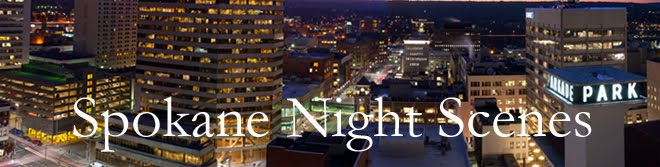
An online archive of nighttime digital photographs, in and around Spokane, Washington. Enjoy the ongoing digital image documentary of Spokane Night Scenes.
I don’t do elections, I just take photos
I got a group of emails from what appear to be local
If I did live inside the City of
Anyhow, I don’t do elections. I just take photos.
John
Getting up early has always seemed to me, to be related to “work.” In my dayshift patrol days at the Spokane Police Department, early was always the optimum word…and it was indeed, “work.” So getting up early now, with a chance to have some fun, just seems a bit tedious. Yet, capturing sunrises with a camera has now been added to my list of fun things to do, and slowly but surely, getting up early is eroding the feeling of it always being “work.”
Sunrises can be as dramatic and as colorful as can sunsets. There is one major exception though, and that is “you must point your camera in a totally opposite direction.” All of the other factors for low light imaging are the same, including the use of a stable tripod platform for the timed exposures.
Sunrises have been a pleasant surprise for me in the past couple of weeks. I have been out of
The placement of the camera and tripod also resulted in the capture of a very large rainbow, which seemed to be less than a hundred yards away. The interior glass did filter a little bit more on that series of shots since it was later in the day, and a lot brighter outside. I may add some of these images to the Spokane Night Scenes website, although I am a little reluctant to add out of town shots to a location designed primarily for Spokane Night photographs. We’ll see, in another week or two when I get back into town and into a normal routine once again.
One thing for sure, getting up early and looking at what Mother Nature is offering for the day, has been fruitful for the past week or two. I need to do more of that back in
John
I began more sojourns into
Then along came the Nikon CP 4500, which was similar in many ways to the Nikon CP 990. I just never got to like that camera as much as the 990, perhaps because it was smaller, yet it offered more megapixels per image (4+). I saw no difference in many ways from the two cameras, but the CP 990 just seemed better in almost every way. There was no significant difference when it came to low light shots.
The Nikon CP 8700 replaced the CP 4500, and in every way was a better piece of hardware. Shooting after dark allowed RAW imaging, as well as JPEG, and the camera allowed easier editing and cropping for written reports since it as an 8 megapixel unit. That camera has been used on many night sojourns from 2003-2005, and is still in use as a backup camera. It was the closest camera to a DSLR I ever had the pleasure to shoot with, and allowed shooting at an ISO of 50, which helped low light images, for noise purposes.
Although the CP 8700 is still up and running, my night visits to Spokane locations are driven by DSLRs, including the Canon 350D (XT), and the Canon 400D (XTi). Both of these units allow for easy lens transfer and placement for a variety of scenes. Shooting at 8 megapixels (350D), and 10+ megapixels (400D), cropping is once again easier, as well as shooting RAW (CR2) plus JPEG. Both cameras allow an ISO level of 100, and that is very helpful in low light situations that I find myself in once or twice each week. There are times that even the Nikon CP 8700 is still used after dark, and having three cameras available at every location allows for a lot of possibilities based on the obstacles that you find when you get there.
Over time, cameras just got better. Considering the beauty of the
Nikon CP 990:
http://www.spokanenightscenes.com/clocktowerbridge.htm
Nikon CP 4500:
http://www.spokanenightscenes.com/rp.htm
Nikon CP 8700:
http://www.spokanenightscenes.com/b3.htm
Canon 350D:
http://www.spokanenightscenes.com/spiresnorthwest.htm
Canon 400D:
http://www.spokanenightscenes.com/landmark.htm
JDM
This week’s efforts included some post-sunset shots utilizing the
This was an experience I had not anticipated. The wind was blowing from the west, and on top of the garage on the west side of Deaconess I really had to keep an eye on the actual focus and blur that did occur when there were gusts of wind. Even with a fairly heavy tripod and not using the center post, still allowed for some movement in the time exposures, on a number of the shots. Bracketing individual scenes was a big help in post photo review, and when there was movement detected for a particular shot, it was almost always replaceable by a number of others taken at the same place and at varying times.
Out of 400 or so images taken during my two hour or so visit to Deaconess, I felt that there were five images that were usable, and a couple others that I am going to have to look closely at over the next week or two. Normally, for me, getting one usable image from 100 taken is about my average. In some cases that is not a fair analogy, since some images used are actually a combination of two or three bracketed images taken at the individual location. Photomatix Pro is a big help on some cases, and using layers in Elements 5 is another sure way of getting what you saw the night you were there.
The top level of the Deaconess parking garage is just west of this building location.
Coming up I have two other locations scheduled, including the rooftop at the Doubletree hotel, and in the area of
JDM
Recently, I became aware that some of my Spokane Night Scenes images were being used by others who had no permission to do so. Initially it was a shock to me, when I saw my images being used commercially and privately without my permission.
In one case, I found one of my images being used by a private party as a part of his blog, on the Internet. After my informing him of his unauthorized use of my image, his reply was,
“I'm very sorry. I have removed the picture, much to my regret. It was a stunning picture.”
How difficult would it have been to send me an email requesting use of my image? Was this person really sorry for using my work, or were they sorry that I found out they were using it? Seems to me that if the image he was using was that impressive to him, he would have made the same contacts with me that many, many others are making when they begin the process of using Spokane Night Scenes images.
Then there is the case of a web design firm who took one of my images and used it on a website designed for one of their clients. Yep, they used it commercially, without permission, even though they were being paid to build a website for a client of theirs. When I discovered the unauthorized use, I contacted them immediately, and got this response. “If you decide to take legal action, I sincerely ask that you involve only myself and my company, ___________ _________. The owners of ____________ are a grassroots company just starting out and trusted me to comply with copyright laws - which I thought I had.”
Come on, I mean really….”THOUGHT I HAD?” How can this be the case? Using something for commercial gain that you don’t own is not exactly a proper use of copyrighted materials.
In the second case, when it was brought to the attention of the web design firm, they bought the limited use rights, allowing them to continue the use of the image owned by Spokane Night Scenes. Sure, this would have and should have been done up front. Ethics, professionalism, and business to business relationships are built on doing things right, and in this case, they finally purchased the use rights.
To own and operate a business, must be the most misunderstood thing around. People just don’t seem to realize all of the costs and liabilities that go hand in hand with operating a business. There are licenses, insurance issues, corporation costs, State and Federal tax issues, Better Business Bureau membership costs, photographic equipment costs, administrative hardware and digital office equipment costs, and the list goes on and on. Yet, in the previously described cases, none of this was important to the former users of the work done by Spokane Night Scenes.
Amazing….. You would think that the web design business had an idea about all the costs to running a business, as well as what it takes to keep the business going…such as income to pay for all of the costs…… Yep, amazing.
Then there are those requests I get, asking to use Spokane Night Scenes for free…for one reason or another. I am as responsive to the needs of some requests as I can be, but bills don’t get paid by giving away everything we produce…. So, I have to limit what is “donated, or given away.” I would much rather donate my time as a photographer, than to compromise the product line of images used to run a business…. Even so, there are those who want, and will, take advantage of that…..
Yep, amazing…
John
(No, I will not ID the people or company involved in these cases….since these issues have been resolved).
A friend related to me some comments made about a photo I had taken at
http://www.spokanenightscenes.com/meadow.htm
The particular image in question was emailed to the Spokane Camera Club for its monthly competition, and I was out of town for the “critique.” The topic of the month was sunsets, and the comments related to me were that the person doing the critique stated that this was not a sunset shot.
It was an image taken at sunset, and timed to be exactly at sunset, with a view of the setting sun in windows rather than the traditional view of the sun setting in the sky on the horizon. Since I was told of those comments, I have always wondered what a sunset really was, if it was not an image of the setting sun along with other objects in the same frame of the shot. The job of critiquing images displayed at a Spokane Camera Club meeting is pretty much a thankless one, and having a professional comment on your shots is geared toward making members better photographers. Yet, if a shot taken at sunset, during a sunset, is not really a sunset photo, then what is? Beats me……
Anyhow, at risk of offending someone for taking another view of
Anyhow, I hope this is a sunset photo, especially one you can enjoy.
http://www.spokanenightscenes.com/landmark.htm
John
For the high and low of it
Providing motion after dark can have some dramatic impact on the actual image capture at a location. Sometimes capturing fireworks can be like that, but in other circumstances it is automobile traffic that provides the motion and the color.
There are some fairly traditional after dark “motion shoots,” in
This week I wanted to find a secondary location, or several of them, if I could. The goal was to capture vehicle motion and color, at sunset through total darkness. The first target this past week came as I faced south towards the moon, on the Clock tower footbridge. This footbridge is close in proximity to the southbound lanes of the couplet, onto
http://www.spokanenightscenes.com/stablur.htm
On another night, I sought out another secondary location, where I could get vehicle lights, in a mostly out of the ordinary photo location. At sunset I took a look at the north end of the Washington Street Couplet overpass, from the ground level. Shooting there looked doable and so about two hours later in total darkness I returned to that spot and set up for another timed exposure. It was a little difficult to judge when northbound vehicles were going to enter the frame, since the east walls of the couplet blocked most of the view. I had to listen to approaching traffic, and then set up an exposure which would be long enough to capture vehicles as they came into view of the camera, as well as when they exited the field of view to the north. (Canon 400d, F16, 8sec, tripod mounted, RAW + JPEG, CR2). What I had not counted on was another STA bus to enter my scene, along with three other vehicles, and all at the same time. The combination of all the vehicle lights, was a big help in displaying the motion and color at the time of the shot.
http://www.spokanenightscenes.com/washlights.htm
At night, there seems to be no
John
Summertime and photography after dark offer up some interesting challenges.
First, to get out with cameras after dark, means that the actual period of darkness comes much later in the evening. So, unless you want to spend hours much later in the day, you may opt to wait until Fall or Winter months.
Or, you get out early in the morning before sunrise, to get the shots of locations during darkness. That condition is not one of my favorite activities, since many of the nighttime lighted buildings or locations will have all of their lights off.
So, I tend to get out there later in the evening and shortening the amounts of time to the places which get visited. For me, it means I have maybe two hours to get shots or get out. On the bright side, it isn’t cold with ice and snow on the ground.
Summer shots after dark in many locations mean that there are much more people activities in progress. I have never been out on a shoot around
There are times when people are going to get into your shots. Usually not a problem, unless your intent was to capture objects and not people. Photoshopping them out of the image after you get the RAW files on your computer might be doable, but taking them out of the frame is not a representation of what you saw when you were at the location. When I was setting up a shot on the Clocktower foot bridge in
http://www.spokanenightscenes.com/stablur.htm
Shooting in the evening is a good deal of fun, even if it requires a late evening/night series of digital shots.
John


Last night I sat down in front of the television, and on Channel 14 (Comcast cable channel) I began to see my pictures appear on the TV screen. Previously I had some discussions about allowing their use for a community television channel, since it was a non profit group. Obviously the people at Channel 14 selected a number of my night shots, and those are now live on Channel 14.
There are some significant differences in resolution, even though I began to look at those night images with a 52” HDTV. Although this is no fault of the staff people at Channel 14, even the low resolution images I place on the web site are so much clearer to look at.
One of my office desktops has a TV tuner, and I brought up Channel 14 on the HP’s 22” monitor, and looking at those images side by side with what is available on the web was drastically different. Regardless, I think that these images of the
John
Some things never seem to change, then again, maybe everything does. In going back to Spokane photo locations more than once, not a single time has that location been as it was when I was there before. It can change so much, that going back to the same location at varying times of evening or night, is almost like a totally different place. The sky is different, streetlights may now be on, building lights (or lack of), or even weather changes. It is just different.
So capturing the same places at different times or even seasons can be a good time. In some cases the conditions have changed so much, it just has to be a different place…yet it isn’t.
For some reason, foggy nights in Spokane seems to be a favorite of some site and gallery visitors. I would never have thought that, in fact I could only think of how crazy it was to be out with a camera in dense fog, the first several times. After speaking or exchanging emails with people about Spokane fog shots, it is now fun to go out there and see how something looks with a blanket of moisture hanging in the air. The photo can get a little noisy with fog, but when you look at it in post editing, there is a lot of mystery there that would not have been there at any other time.
John D. Moore, CPP
Spokane Night photos
The end of the year 2006 is upon us, and it means I have lots of things to do with the cameras. First Night begins with the kid’s event at the new convention center, and then shooting photos for the rest of the night downtown. 6-8 members of local camera clubs are volunteering their time to photograph as many events as they can, so I won’t be the only one with a couple of cameras trying to document the nights activities.
Then, January 5th, is First Friday Art Walk. I just completed a transition of many of the Spokane Night Scenes prints which were displayed in December, so there are many new ones on the Wall at Gina’s Design Corner at 1st and Browne. The artist reception runs from 5PM to 8PM on January 5th, at Gina’s. What a great group of people, and they really know how to have a party at the artist receptions. If you get a chance, stop by and enjoy the new Spokane Night Scenes photographs, as well as the refreshments provided by the interior designers at Gina’s. It should be a good time.
I have been provided with some photo op suggestions for the Spokane area, so in January I will be out shooting at the locations some of you have identified.
Lots to do over the next week and then lots more Spokane Night Scenes photos to do around Spokane.
JDM
Last night was a slow night in Riverfront Park, but there were some visual changes in the surrounding environment. One thing noticed right away was the fact the Parkade sign is now illuminated. Last time I was shooting in the park, that sign atop the Parkade building downtown was dark. The fact it was illuminated is a good thing and also a challenge for a camera. The extra light from the letters can blow out a photo with its brightness. I bracketed the shots from darker to lighter, with the darker images reproducing the Parkade letters pretty well. Of course that almost eliminates the details on most other things, so this week editing will attempt to establish the entire scene, by layering, erasing, reducing some opacity, and feathering the edges.
The sign at Anthony's caught my eye, so I shot a number of frames adjacent to Anthony's, and their FISH came out really detailed. Editing should allow that one to get online this week.
I found a clear area to photograph the east side of the WWP/Avista building. The green letters have always been readily identifiable, but with some in-camera image reviews I noticed a lot of the lighting in the Washington Water Power letters visibly dark. Dark spots appear periodically in the green letters, to the point I may not be able to upload those images to the web. I'll look again this week to see if there is another way to produce clean and clear green letters, without the letters looking like a paint or clone job. We shall see.
A great moon last night, with brief moments of the moon bouncing lights off ample passing clouds. In the area of the reflection rocks and bridges (west side of the park), the moon gave off some bright light, so I hope to get at least one of those images online, bringing out the details of the ground and rock surfaces.
The park is a great place to take a camera and tripod, and no matter how many times you look around, something has changed. Even the deciduous trees and shrubs are making their seasonal changes, and they are visible even in low light conditions. Riverfront Park is just a photogenic environment, and changes occur with or without any man made assistance. It’s plainly an enjoyable experience, and easy on the eyes and camera lens.
John
